
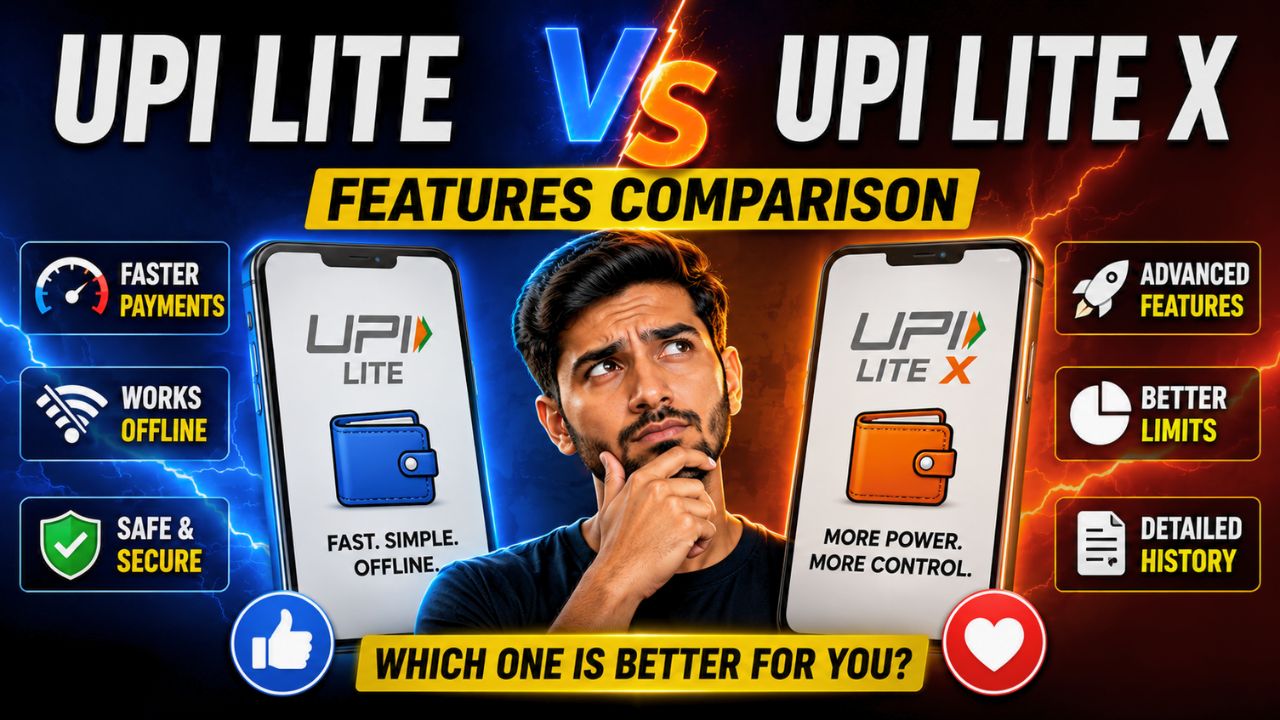
For most people, UPI simply means scanning a QR code and making a payment. But over the last few years, NPCI has quietly introduced new versions of UPI designed to make small payments faster and more reliable. Two of the most talked-about features are UPI Lite and UPI Lite X.
At first glance, both look very similar. Neither requires a UPI PIN for every small transaction, both are designed for low-value payments, and both aim to reduce transaction failures. Because of this, many users assume they are the same thing.
They are not.
The biggest difference is that one still depends on internet connectivity, while the other is designed to work even when your phone has no network access. That single change can completely transform how digital payments work in crowded places, remote locations, and areas with poor connectivity.
What Is UPI Lite?
UPI Lite is essentially a lightweight payment balance that sits on your device and is designed specifically for small-value transactions. Instead of directly contacting your bank account every time you make a payment, transactions are processed from a preloaded balance.
The main advantage is speed.
Since the payment comes from your UPI Lite balance, you don’t have to enter a UPI PIN every time for small purchases. This makes it useful for everyday transactions like tea stalls, local shops, public transport, and small merchant payments.
Another benefit is that these micro-transactions don’t clutter your main bank statement, making account tracking much cleaner.
What Is UPI Lite X?
UPI Lite X takes the same concept and pushes it further.
Instead of only simplifying small payments, it introduces the ability to make transactions even when internet connectivity is unavailable. It uses NFC technology to enable offline transactions between supported devices. In simple terms, users can make certain payments even in low-network or no-network environments.
This is particularly useful in places like:
- Underground metro stations
- Remote villages
- Large events with network congestion
- Areas with poor mobile coverage
For users who frequently experience failed UPI transactions because of connectivity issues, UPI Lite X is arguably one of the most important innovations introduced by NPCI in recent years.
UPI Lite Vs UPI Lite X – Feature Comparison Table
| Feature | UPI Lite | UPI Lite X |
|---|---|---|
| Internet Required | Yes | No (for supported offline transactions) |
| Transaction Type | Small-value digital payments | Small-value offline and online payments |
| Technology Used | On-device wallet | On-device wallet + NFC |
| UPI PIN Required | No | No |
| Payment Speed | Fast | Extremely fast |
| Offline Payments | No | Yes |
| Works in No-Network Areas | No | Yes |
| Best For | Daily micro-payments | Travel, remote areas, crowded locations |
| Balance Source | Preloaded Lite balance | Same Lite balance |
| Security | Device-based protection | Device-based protection + NFC validation |
Sources: NPCI, PhonePe, Ujjivan SFB, Economic Times BFSI.
Why UPI Lite X Could Be More Important Than It Looks
Most people focus on speed when discussing digital payments.
The bigger issue is reliability.
Think about how often UPI payments fail because of poor network conditions. Sometimes the merchant’s internet is slow. Sometimes your mobile network disappears at the worst possible moment.
UPI Lite X attempts to solve that problem by reducing dependence on internet connectivity during the transaction itself. This means digital payments can continue working in situations where traditional UPI might struggle.
That may sound like a small upgrade, but in practice it could make digital payments more dependable across India.
Security and Privacy Differences
Both systems are designed within the NPCI framework and use the security standards already associated with UPI.
However, because UPI Lite X performs transactions using NFC and on-device balances, sensitive information doesn’t necessarily need to travel through the internet during every payment. This can reduce certain connectivity-related risks while maintaining convenience.
At the same time, users should remember that UPI Lite X is designed for smaller payments rather than large-value transfers.
Which One Should You Choose?
The answer depends on how you use digital payments.
If most of your transactions happen in cities with stable internet connectivity, UPI Lite is already sufficient. It is simple, fast, and removes the need to enter a PIN for every small purchase.
If you frequently travel, experience network issues, use public transport regularly, or want a payment method that can continue working even when connectivity fails, UPI Lite X offers a clear advantage. Its offline capability is the biggest reason it exists.
Will UPI Lite X Replace UPI Lite?
Probably not.
A more realistic scenario is that UPI Lite X becomes an extension of UPI Lite rather than a replacement. In fact, Lite X is already built on the same Lite balance system and is designed to work alongside it.
For most users, the future may involve using both without even thinking about the difference. Payments could automatically switch between online and offline modes depending on connectivity.
Final Takeaway
The UPI Lite Vs UPI Lite X debate isn’t really about which one is better. It’s about understanding the problem each feature is trying to solve.
UPI Lite makes small payments faster by removing PIN entry and reducing bank dependency. UPI Lite X goes a step further by allowing supported transactions to work even when internet connectivity becomes unreliable.
As India continues to expand digital payments into every corner of the country, features like UPI Lite X could become just as important as the original UPI itself.