
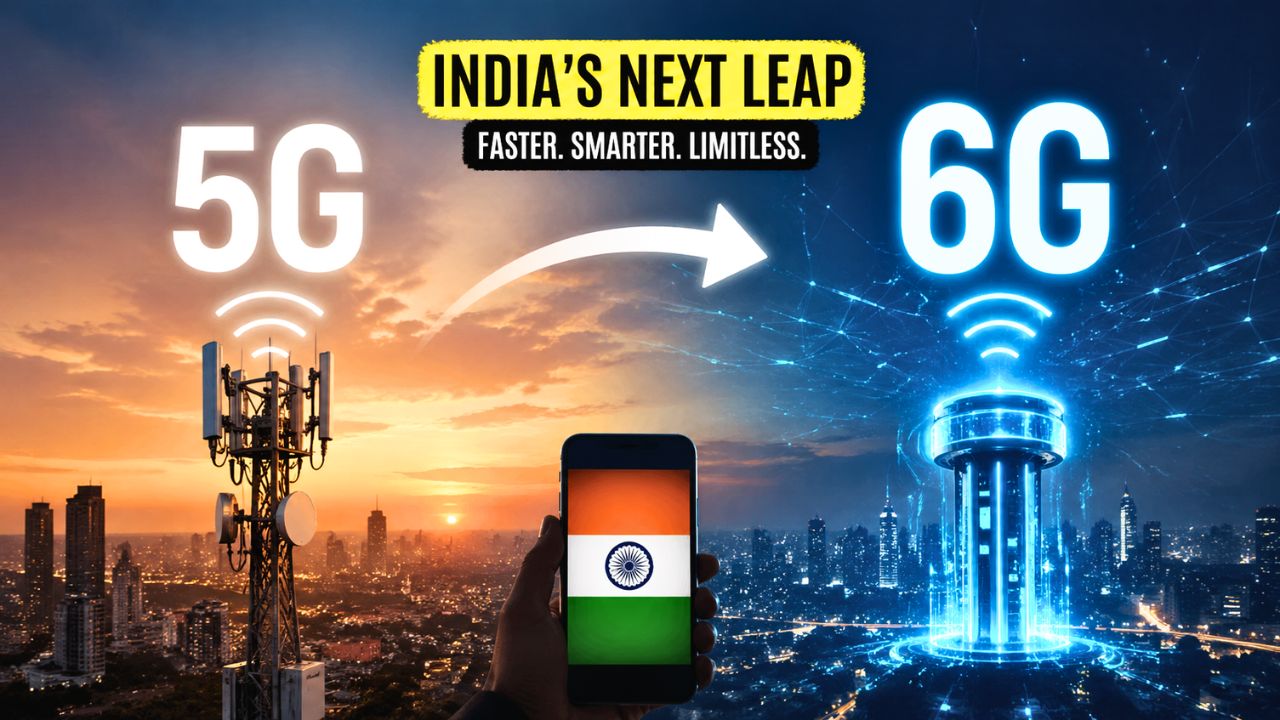
5G isn’t fully stable in India yet, but the government and telecom companies have already begun work on 6G. At first glance, this seems a bit confusing, why is there talk of 6G when 5G hasn’t even reached everywhere?
The real reason is timing. Network technology upgrades don’t happen overnight. Developing next-generation networks like 6G takes years, so research and planning have begun now.
Recently, the Indian government has approved more than 100 research projects for 6G technology, on which approximately ₹271 crore is being invested.
It is clear from this that India is not only preparing to use 6G but is also preparing to develop it.
The difference between 5G and 6G is not just speed.
Most people think that 6G just means faster internet, but the real difference is much bigger than that.
5G was primarily designed for fast internet and low latency. But the focus of 6G is on creating intelligent networks—networks that can decide for themselves how to manage data.
6G में expected improvements:
- Ultra-high speed (many times more than 5G)
- Near-zero latency
- AI-powered network management
- Better connectivity even in crowded areas
Even at the global level, 6G is being considered not just as faster internet but also as an AI-driven communication system.
What is India doing on 6G right now?
India is not late in this race, but has entered in the early stage itself.
The government launched the “Bharat 6G Vision” in 2023, with the goal of making India a global leader in 6G development by 2030.
Other than this:
- Bharat 6G Alliance Formed
- Research support is being provided to universities and startups
- 100+ projects already underway
- Spectrum planning has started
India’s focus is not just on using the network, but on taking part in future telecom technology.
When will 6G arrive in India?
If we talk about practical timeline, then 6G is not going to be available to users right now.
According to experts and global reports:
- Initial rollout around 2028–2030
- Early stage में limited cities
- Full adoption will take several years
Global telecom companies also believe that 6G will come on commercial level in the early 2030s.
The meaning is simple –
👉 5G will remain the main network for the next few years.
Should you consider 6G now?
Short answer: No.
5G phones and networks are fully relevant right now, and will remain so for years to come. 6G will require new devices, new infrastructure, and a new ecosystem, which will be built gradually.
If you’re buying a phone right now, there’s no point in thinking about 6G future-proofing.
What will be the real impact on users?
When 6G arrives, the change will be seen gradually, not suddenly.
In the future you may get:
- Almost instant downloads
- Lag-free gaming and real-time applications
- Smart devices and better integration
- AI-based services with faster response
But all this will be possible only when the apps and ecosystem also evolve.
The most important thing people miss
It is important to understand one thing clearly here. 6G is not coming to replace 5G, but to upgrade it.
Just as 4G still exists, 5G will continue to exist in the future. Network layers upgrade gradually, not suddenly.
Final takeaway
India’s transition from 5G to 6G is not a sudden change, but a long-term strategy. Currently, the focus is on 5G expansion, but groundwork is being laid for the future on 6G.
If you’re a normal user, 5G is what you need right now. 6G is the future, but it will arrive gradually and when it does, the experience will not only be faster, but also smarter.