
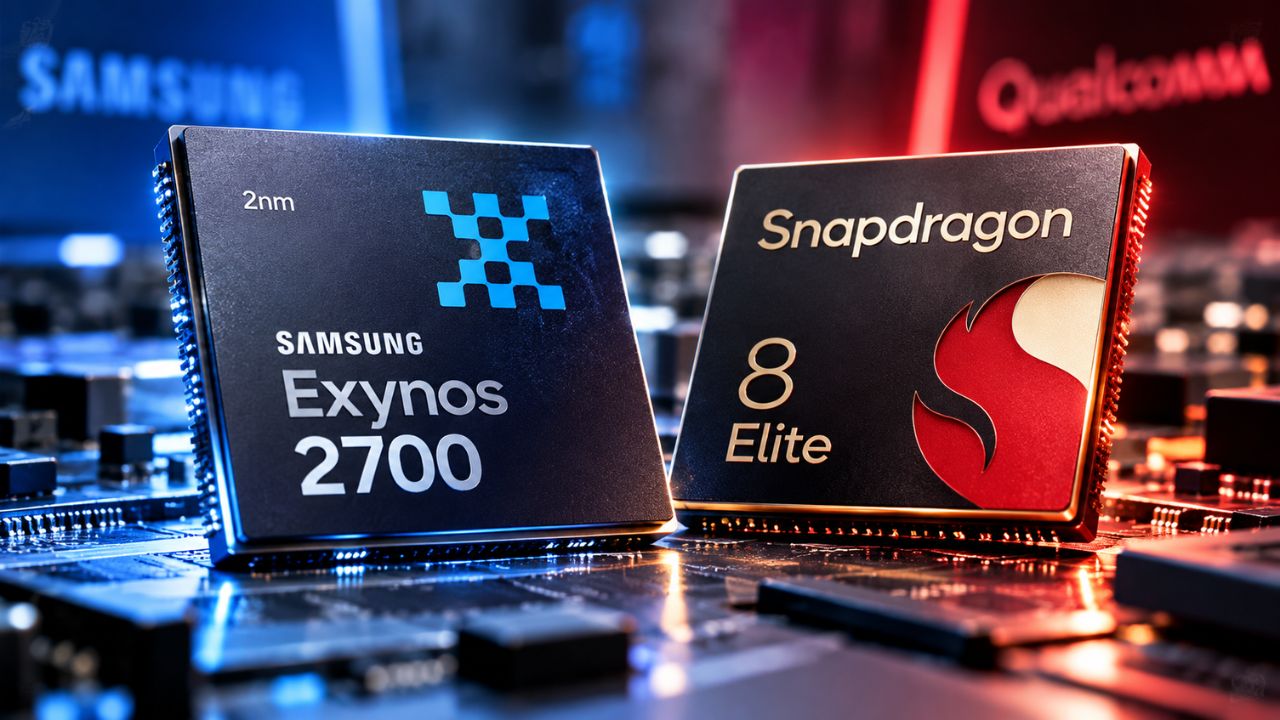
For nearly a decade, the mobile processor landscape followed a predictable pattern: Samsung’s flagship Exynos chips struggled with thermal throttling and peak graphics stability compared to Qualcomm’s Snapdragon silicon. However, leaked internal benchmark numbers for Samsung’s upcoming Exynos 2700 suggest that balance might be shifting dramatically ahead of the next Galaxy generation.
Fresh preliminary tests circulating from internal evaluation boards show the 2nm-based Exynos 2700 holding a notable lead in multi-core throughput and GPU efficiency over rival Qualcomm Snapdragon hardware.
1. Geekbench CPU Scores: Where the Numbers Stand
Early synthetic benchmark logs indicate a massive generational jump for Samsung’s silicon division:
- Geekbench Multi-Core Performance: The Exynos 2700 reportedly achieved an unverified multi-core score hovering around 13,000 points in Geekbench 6.5 testing.
- The Snapdragon Comparison: Qualcomm’s competing next-generation Snapdragon flagship platform scored in the 11,000-point range on comparable test rigs.
- The Delta: As reported in early testing analyses tracked by TelecomTalk’s chipset benchmark coverage, this represents an estimated 15% to 20% multi-core performance advantage in initial synthetic runs.
2. 2nm Foundry Node vs TSMC Architecture
The performance battle this time hinges heavily on fabrication node advancements:
| Specification Parameter | Samsung Exynos 2700 (Reported) | Qualcomm Snapdragon Flagship (Expected) |
| Manufacturing Process | Samsung 2nm GAA (SF2P Process) | TSMC 2nm / Advanced Node |
| Core Configuration | Redesigned 10-core cluster | Custom Oryon core layout |
| Graphics Unit | AMD-partnered Xclipse 970 GPU | Adreno Flagship Architecture |
| Primary Deployment | Select Galaxy S27 global variants | North American / Global flagships |
Samsung’s shift to its second-generation 2nm Gate-All-Around (SF2P) architecture is built specifically to address power leakage—the root cause behind previous Exynos overheating reports.
3. Gaming & Graphics: Peak Boost vs Real-World Load
Beyond raw CPU numbers, early graphics data highlights interesting trade-offs:
- Sustained vs Burst GPU Output: Initial tests indicate that the new Xclipse graphics processor provides roughly a 20% spike in peak gaming benchmark suites. However, during continuous 3D game simulations, that gap narrows closer to 5%.
- Current Draw and Battery Drain: Preliminary current-draw telemetry points to approximately 12% lower power consumption during demanding background processes, though real-device cooling setups will dictate how long those gains hold up.
4. Benchmark Hype vs Real-World Reality
While these benchmark leaks generate immense excitement, real-world context remains essential:
- Open Test Rigs vs Sealed Phones: Early testing often takes place on open motherboard platforms with external cooling fans. Whether the Exynos 2700 can maintain peak clock speeds inside a 7.5mm sealed smartphone chassis without throttling remains unverified.
- Pre-Production Drivers: Firmware for next-gen silicon undergoes continuous thermal patching right up to retail distribution. Final retail unit performance will vary once commercial devices hit shelves early next year.