You get a text saying you owe an unpaid toll. Or a “USPS” message says your package is on hold. Or a caller claims to be from the FTC and says your phone number is linked to fraud. Your first question is simple: is this a scam?
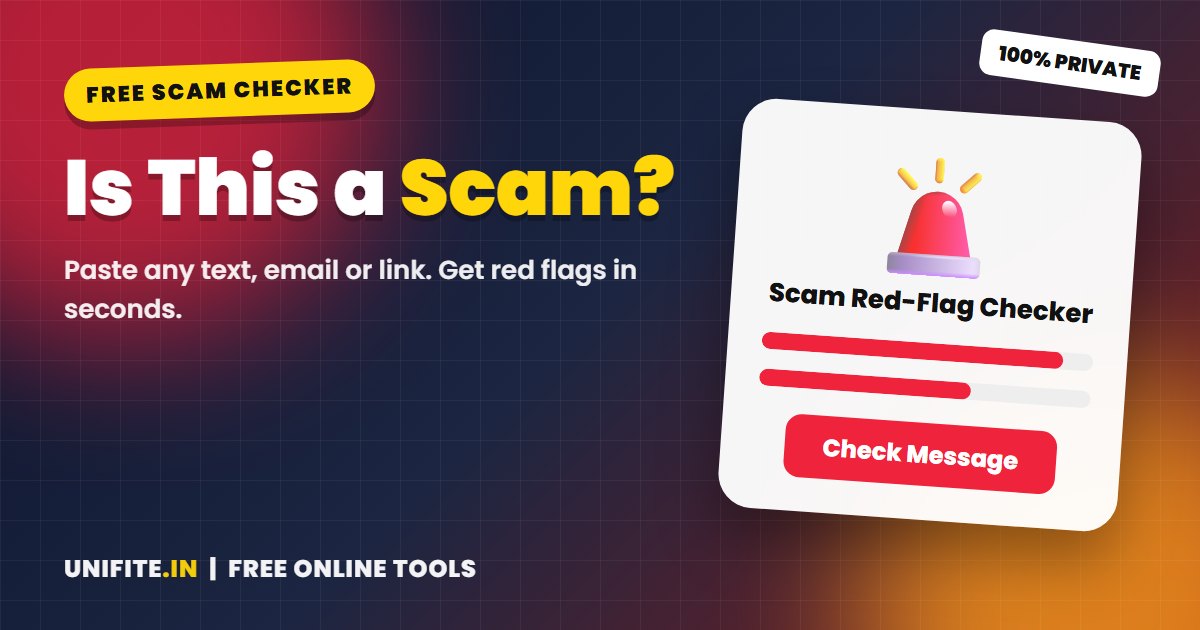
Use the free Is This a Scam? checker below. Paste the text message, email, DM or what the caller told you. It scans for the red flags that show up in most scams reported in the US, then tells you what to do next. It works only in your browser, so nothing you paste is uploaded or saved.
How the Scam Checker Works
The checker looks for patterns that scammers use again and again. It does not need your phone number, your name or any account access. It checks things like:
- Payment requests by gift card, crypto, Bitcoin ATM, wire transfer, Zelle or Cash App.
- Requests for codes, passwords, PINs or your Social Security number.
- Urgency and threats such as “pay within 24 hours”, “your license will be suspended” or “a warrant has been issued”.
- Impersonation of the IRS, FTC, Medicare, USPS, toll agencies, banks and big brands.
- Suspicious links like short links and cheap web addresses.
- Fake prizes, refunds, jobs and investments.
Each red flag adds to the risk score. A message with several red flags is very likely a scam. A message with no red flags is not automatically safe, so always verify when money or your account is involved.
The Most Common Scam Texts in the US Right Now
Scam messages change all the time, but these types keep coming back:
Unpaid toll texts
The message says you owe a small toll and must pay today to avoid late fees. Real toll agencies such as E-ZPass usually bill by mail or through your account. Check your balance on the official website or app, not through the link.
Fake delivery texts
“Your package could not be delivered. Update your address.” These texts want a small “redelivery fee” and your card number. If you are expecting a package, use the tracking number from the store’s official email.
Fake FTC or government calls
A caller says they work for the FTC, IRS or Social Security and your number is linked to a crime. They ask you to move money to “protect” it. Government agencies do not threaten you by phone or ask for gift cards, crypto or wire transfers.
Bank fraud alert texts
“Did you try to spend $500? Reply YES or NO.” Then someone calls pretending to be your bank and asks for a code. Your real bank will never ask you to read back a code.
Job and task scams
You are offered easy money for liking videos or rating products. First you earn a little, then you are asked to deposit money to unlock bigger tasks. That money is gone.
Fake Black Friday stores
Social media ads lead to shops selling famous brands at 70% off that never ship anything. Before you buy, run the store through our free Black Friday fake store checker.
What to Do If the Checker Finds Red Flags
- Do not click the link, call the number or reply. Even replying “STOP” confirms your number is active.
- Verify on your own. Open the company’s official app or type its website yourself.
- Report the text by forwarding it to 7726 (SPAM), then block and delete it.
- Report the scam to the Federal Trade Commission at ReportFraud.ftc.gov.
- Already paid or shared details? Follow our step-by-step scam recovery plan right away. Speed matters.
How to Spot a Scam in 5 Seconds
If you remember only one thing, remember this: scammers want you to act fast, keep it secret and pay in a way that cannot be reversed. Any message that pushes all three is a scam, no matter whose name is on it.
Scams on Instagram and Social Media
Scammers are very active on Instagram and Facebook. Watch out for fake brand deals, giveaway “winners” who must pay a fee, and accounts that copy a friend’s profile. If your feed suddenly fills with get-rich-quick content, use our Instagram algorithm reset planner to clean it up. Creators who get “sponsorship” offers can check if the money makes sense with our creator earnings calculator.
Frequently Asked Questions
Can this tool tell me for sure if a message is a scam?
No tool can be 100% sure. The checker finds common warning signs. If money, passwords or personal information are involved, always contact the company yourself using its official website or app.
Is it safe to paste a message into the checker?
Yes. The checker runs in your browser. The text is not sent to our server or stored anywhere. Still, remove your own account numbers before pasting, as a good habit.
What if I already clicked a scam link?
Close the page, do not enter any details, and run a security scan on your device. If you typed a password, change it now. If you entered card details, call your card issuer using the number on the back of your card.
How do I check if a phone number is a scam?
Search the number online with words like “scam” or “complaints”, and never call back a number from a suspicious message. Look up the official number on the company’s website instead.
Where do I report scam texts in the US?
Forward the text to 7726, report it in your messaging app, and file a report with the FTC. If you lost money, also contact your bank right away.