
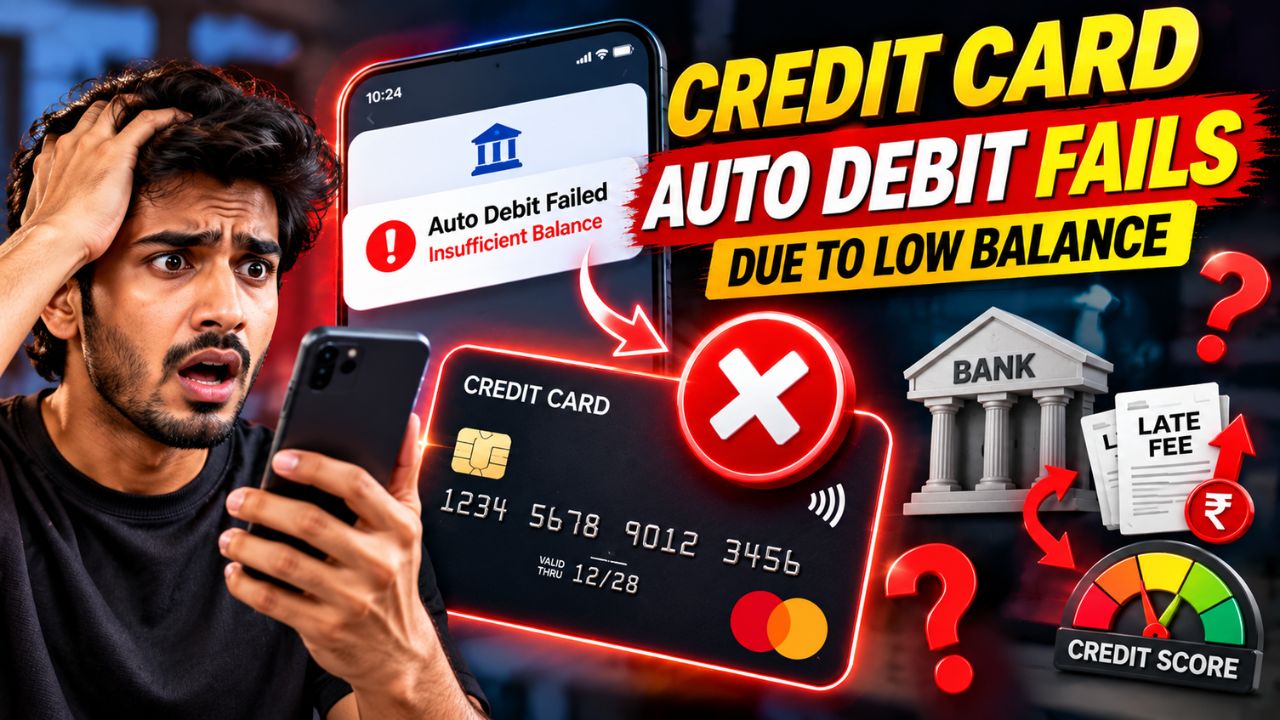
If you have enabled credit card auto debit from your bank account, you probably expect your bill to be paid automatically on the due date. But what happens if there isn’t enough money in your bank account when the payment is attempted?
A failed auto-debit does not mean your credit card bill has disappeared or been paid automatically later. The payment can be returned or fail, and you may then need to make the credit card payment manually.
The consequences depend on your card issuer, the type of auto-debit mandate and whether you manage to pay the required amount within the applicable payment window.
If the Minimum Amount Due is not paid by the due date, late-payment charges and interest can apply. CIBIL also warns that missed credit-card payments can negatively affect your credit profile.
What Happens When Credit Card Auto Debit Fails?
Let’s say your credit card bill is ₹25,000, and you have enabled auto debit from your savings account.
On the payment date, your bank account has only ₹5,000.
The auto-debit instruction may fail because there isn’t enough money to cover the required debit.
At that point, the credit card bill is still outstanding.
You should therefore check your credit card account immediately and make the required payment through another available method rather than assuming the failed auto-debit will automatically be retried successfully.
Will You Be Charged for a Failed Auto Debit?
Possibly.
There can potentially be two different types of charges:
- A charge associated with the failed debit/mandate from the bank or payment system.
- Credit-card late-payment charges and interest if the required card payment is not made on time.
The exact amount depends on the bank, card issuer, mandate and applicable terms and conditions. Historical RBI material on ECS also shows that banks can levy return charges for transactions returned because of insufficient funds, although current charges must be checked with your bank.
This is why you should not assume that a failed auto-debit will only cost you a small bounce fee.
What If You Pay the Credit Card Bill Immediately After the Failed Debit?
This is where timing becomes extremely important.
Suppose your credit card payment is due on October 10, but your auto-debit fails because your bank account doesn’t have enough money.
If you notice the failure and immediately make the required payment through another payment method, you reduce the risk of the account remaining overdue.
However, don’t assume that every issuer will treat every failed mandate identically. Check your card statement and the issuer’s payment terms to confirm whether the payment has been successfully credited.
The safest approach is simple:
Check → Pay manually → Confirm the payment → Keep the transaction reference.
Does a Failed Auto Debit Automatically Affect Your CIBIL Score?
Not necessarily in the same way as a prolonged missed payment.
The important issue is whether your credit-card payment becomes overdue and how the lender reports your repayment behaviour.
CIBIL says payment history and the magnitude of overdue payments are factors that can affect your CIBIL Score. It also states that missed credit-card payments can negatively affect your credit profile.
So if an auto-debit fails and you leave the bill unpaid, the situation can become much more serious than simply paying a small failed-mandate charge.
What If You Miss the Minimum Amount Due?
This is the situation you should avoid.
Your credit-card statement normally shows a Total Amount Due and a Minimum Amount Due.
If you fail to pay the required minimum amount by the applicable due date, the issuer may charge a late-payment fee and interest according to the card’s terms.
CIBIL explains that failing to pay the Minimum Amount Due by the due date can result in late-payment charges and interest on the outstanding amount.
That is why a failed auto-debit should never be ignored.
Does Interest Start Immediately After an Auto-Debit Fails?
It depends on the circumstances and your card’s terms.
A failed auto-debit itself is not the same thing as a new credit-card purchase. The bigger concern is whether the required payment remains unpaid after the applicable due date.
If your payment is late, interest and other charges may apply according to your card’s terms and the applicable regulations.
CIBIL notes that credit-card interest can be substantial and that carrying unpaid balances can cause the amount owed to increase significantly over time.
So don’t leave the outstanding balance sitting there while waiting for another auto-debit attempt.
Can the Bank Try the Auto Debit Again?
A retry may be possible depending on the issuer, mandate and payment system, but you should not rely on an automatic retry.
If your auto-debit fails, the safest option is to open your credit-card app or net-banking account and check the payment status.
If the bill still shows as unpaid, make the payment manually.
This is particularly important when you’re close to the payment due date because waiting for a possible retry could allow the payment to become overdue.
What Should You Do If Your Auto Debit Failed?
Follow these steps:
1. Check Your Bank Account
First, confirm why the auto-debit failed.
If the reason was insufficient balance, transfer enough money into the account if you plan to use the same account for another payment attempt.
2. Check Your Credit Card Statement
Open your bank’s app or website and check whether the credit-card payment is showing as successful, pending or failed.
Don’t rely only on an SMS notification.
3. Make the Payment Manually
If the bill remains unpaid, make the payment using another available payment method.
Try to pay at least the required amount by the applicable deadline, and preferably clear the full outstanding amount if you can comfortably afford it.
4. Confirm the Payment
After making the payment, check that the amount has actually been credited to the card.
Keep the payment confirmation or transaction reference until the payment is reflected correctly.
5. Check for Charges
Look at your next statement to see whether a failed-payment, late-payment or other applicable charge has been added.
If you believe a charge was incorrectly applied, contact the card issuer and raise a complaint.
Example: ₹50,000 Credit Card Bill With Low Bank Balance
Imagine your credit card bill is:
Total Amount Due: ₹50,000
Your auto-debit is linked to your savings account, but only:
₹10,000
is available on the payment date.
The auto-debit may fail because the available balance is insufficient.
Now imagine you ignore the failed payment.
The credit-card bill remains unpaid, and if the required payment is not made by the applicable deadline, you could face late-payment charges and interest.
Instead, if you immediately notice the failed debit and arrange the required funds, you can make the payment manually and avoid allowing the situation to escalate.
The lesson is simple:
Don’t wait for the bank to fix it automatically. Check the card account yourself.
What If You Only Have Enough Money for the Minimum Due?
If you cannot pay the entire credit-card bill, paying the Minimum Amount Due by the applicable due date may help you avoid the account being treated as a missed minimum payment, but it does not make the borrowing cost-free.
Interest can continue to apply to the remaining outstanding balance according to your card’s terms.
CIBIL specifically warns that making only minimum payments can cause the outstanding balance to grow substantially over time.
So paying the minimum should generally be viewed as a short-term fallback, not a regular strategy.
Does a Failed Auto Debit Mean Your Credit Card Will Be Blocked?
Not necessarily.
A single failed auto-debit does not automatically mean your credit card will be permanently blocked.
However, if the bill remains unpaid and the account becomes seriously overdue, the issuer may take action according to the card’s terms.
The exact consequences depend on the issuer, the length of the overdue period and the account status.
If your card stops working after a failed payment, contact the issuer rather than assuming the card has been permanently cancelled.
What If the Bank Account Had Enough Money but Auto Debit Still Failed?
This is a different situation.
If sufficient funds were available but the payment still failed, check:
- Whether the auto-debit mandate is active
- Whether the mandate has expired
- Whether your bank rejected the transaction
- Whether the credit-card issuer received the payment instruction
- Whether there was a technical or processing issue
- Whether the account details or mandate were changed
Take a screenshot of the failed transaction and contact the relevant bank or card issuer if necessary.
If you believe a payment or credit-information issue has been incorrectly reported, you can also raise a dispute with the relevant institution. CIBIL says disputes relating to credit-information updates are subject to the RBI’s prescribed resolution framework.
How to Avoid Credit Card Auto Debit Failure
The easiest solution is to keep enough money in the linked bank account before the payment date.
You can also:
- Keep a small buffer above the expected bill amount.
- Check your credit-card statement a few days before the due date.
- Don’t rely exclusively on auto debit.
- Enable payment notifications.
- Keep an alternative payment method available.
- Check whether your auto-debit mandate is still active.
- Review your bank balance before the scheduled debit.
- Avoid spending the money reserved for your credit-card payment.
A useful habit is to treat the credit-card bill as money that has already been spent, even if the bank hasn’t debited it yet.
Is Auto Debit Better Than Manual Credit Card Payments?
For many people, yes.
Auto debit can reduce the chance of forgetting a payment date. But it doesn’t eliminate the need to monitor your account.
If the linked bank account has insufficient funds, the automatic payment can fail.
So the best setup is:
Auto debit + sufficient balance + payment alerts + occasional manual checking.
Don’t treat auto debit as a completely hands-off system.
What Happens If You Repeatedly Fail Auto Debit Payments?
Repeated failures are more concerning than a single accidental failure.
If you regularly don’t keep enough money in the linked account, you could repeatedly incur applicable failed-payment charges, miss credit-card payment deadlines and accumulate interest.
Repeated late payments can also damage your credit profile.
CIBIL states that payment history is an important part of credit behaviour and that missed payments can affect access to credit in the future.
If you frequently struggle to fund the full card bill, it may be better to reduce new spending and create a repayment plan instead of repeatedly relying on auto debit.
Final Takeaway
If your credit card auto debit fails because of low balance, don’t panic but don’t ignore it either.
First, check whether the payment actually failed. Then check your credit-card account and make the required payment manually if the bill is still outstanding.
A failed auto-debit can potentially result in a bank or mandate-related charge, while an unpaid credit-card bill can lead to late-payment charges, interest and potential damage to your credit profile. The exact charges and treatment depend on your card issuer and the applicable terms.
The safest habit is to keep enough money in your linked account before the due date and verify that the credit-card payment has actually gone through.
For authoritative information, check your card issuer’s latest terms and CIBIL’s guidance on missed credit-card payments. CIBIL – Credit Card Guidance






![How to reduce battery drain after [AndroidiOS version] update](https://unifite.in/wp-content/uploads/2026/10/How-to-reduce-battery-drain-after-AndroidiOS-version-update-100x70.jpg "How to Reduce Battery Drain After an Android or iOS Update (2026)")
![Best educational apps for adults learning [skill]](https://unifite.in/wp-content/uploads/2026/10/Best-educational-apps-for-adults-learning-skill-100x70.jpg "Best Educational Apps for Adults Learning New Skills in 2026")