
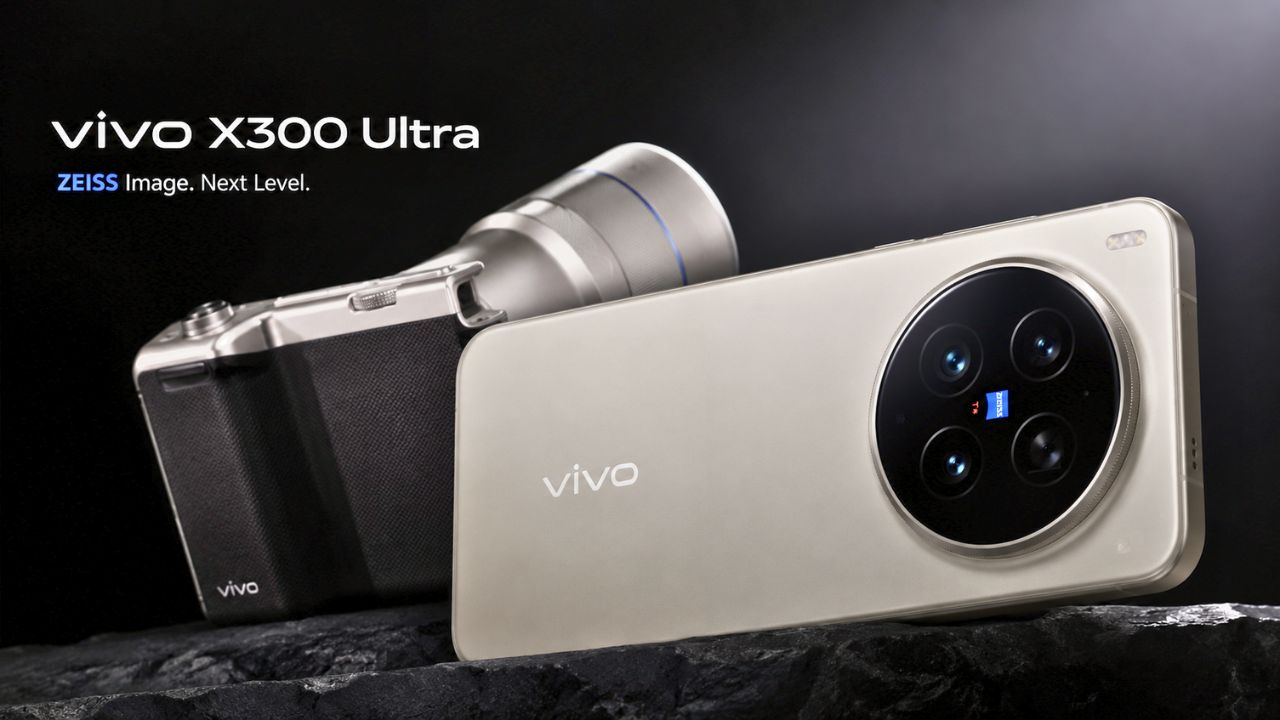
Most flagship smartphones today promise “pro-level cameras,” but after using the Vivo X300 Ultra throughout an entire day focused almost entirely on shooting videos and photos, it becomes clear that Vivo is approaching things a little differently this year.
This phone does not feel like a flagship with a good camera attached to it. Instead, it feels like a professional camera system that also happens to be a flagship smartphone.
That difference becomes obvious the moment you start using it.
The camera setup is clearly the main focus
Vivo has pushed the camera hardware aggressively on the X300 Ultra, especially when it comes to videography. The rear setup includes a 200MP primary camera, a 200MP telephoto lens, and a 50MP ultra-wide camera.
Vivo X300 Ultra Camera Specs
| Feature | Details |
|---|---|
| Main Camera | 200MP with OIS |
| Telephoto Camera | 200MP with OIS |
| Ultra-Wide Camera | 50MP with OIS |
| Video Recording | Up to 4K 120fps on all rear cameras |
| Log Recording | Supported |
| Focal Lengths | 14mm, 35mm, 85mm |
| Special Tuning | Zeiss optics integration |
What makes this setup more interesting is that all three cameras support optical image stabilization and can shoot 4K at 120fps. Vivo has also matched the video capabilities across all lenses instead of limiting premium features to just one camera, which is something many smartphones still do.
The inclusion of Log recording support shows that Vivo is targeting creators who want more flexibility while editing footage later.
Video recording feels like the real upgrade this year
Photography on Vivo flagships has already been strong for a while, but this time the bigger jump feels visible in video recording.
During outdoor shooting, movement looked smoother, stabilization remained consistent, and switching between focal lengths felt much more usable compared to many other smartphones. The footage has a more cinematic look, especially when recording in 4K 120fps.
One thing that stands out immediately is how serious Vivo seems about focal lengths this year. Instead of the standard smartphone-style 24mm main camera, Vivo has gone with a 35mm perspective. This gives videos and photos a slightly tighter and more natural framing, similar to traditional camera lenses.
At first, it takes a little getting used to because it feels more zoomed-in compared to typical smartphones, but after some time, the framing actually starts to look more professional.
The telephoto extender kit changes the experience completely
One of the most unusual additions is Vivo’s external telephoto extender kit. Instead of relying only on digital zoom, Vivo is offering attachable 200mm and 400mm lenses designed specifically for the phone.
Vivo X300 Ultra Extender Kit Features
- 200mm and 400mm external lenses
- Dedicated camera grip
- Zoom wheel and video recording button
- Support for ND and CPL filters
- Modular attachment system
The 400mm lens, in particular, feels surprisingly impressive for a smartphone accessory. It allows the X300 Ultra to capture shots that are normally impossible on regular phones without heavy digital cropping.
This setup obviously will not appeal to everyone because smartphone photography is usually about convenience and portability. But for users who genuinely care about long-range photography or creative videography, this becomes a very interesting option.
Battery life holds up surprisingly well
Heavy camera usage usually destroys battery life quickly, but the X300 Ultra handled things better than expected.
After several hours of continuous photo and video recording, the battery still had around 80% remaining during the afternoon. By the end of the day, after extensive camera usage and content playback, the phone still had usable charge left.
That is impressive considering how demanding 4K 120fps recording can be.
Performance and display feel properly flagship-level
Even outside the camera experience, Vivo has not compromised on core flagship features.
Vivo X300 Ultra Key Specifications
| Feature | Details |
|---|---|
| Processor | Snapdragon 8 Gen 5 |
| Display | 2K AMOLED |
| Refresh Rate | 144Hz |
| Peak Brightness | 4500 nits |
| Software | OriginOS 6 |
| Protection | IP69 rating |
| Charging | Fast charger included |
The Snapdragon 8 Gen 5 handles everything smoothly, whether it is gaming, multitasking, or heavy camera processing. The display also feels premium with its sharp 2K resolution and high brightness levels, especially while viewing HDR content outdoors.
OriginOS 6 adds a modern feel to the software experience. Animations are smooth, and the UI feels cleaner compared to older Vivo software experiences.
The biggest downside is obvious
There is one thing you notice immediately after holding the phone for some time.
It is huge.
The camera module itself is extremely large, and the overall phone feels bulky compared to most flagship devices. If you prefer compact smartphones, this may take time to adjust to.
But at the same time, the size also reflects what Vivo is trying to achieve here. This phone is clearly prioritizing camera hardware above everything else.
Photography is still among the best
Even though Vivo focused heavily on videography this year, photography performance remains excellent.
Portrait shots continue to be one of Vivo’s strongest areas. Edge detection, background blur, and skin tones look consistently good across different lighting conditions. The phone produces images that feel polished without looking overly artificial.
Across ultra-wide, primary, and telephoto perspectives, the consistency remains impressive.
Final takeaway
The Vivo X300 Ultra feels less like a traditional smartphone upgrade and more like Vivo trying to push smartphone cameras as far as possible within physical limits.
Not everyone will need the external lenses or advanced video features, but for creators who shoot a lot of content directly on their phone, this device starts making a very strong case for itself.
The phone is bulky, expensive, and clearly camera-focused, but that is also exactly what makes it stand out. Vivo is not trying to make a safe flagship here. It is trying to build one of the most capable smartphone camera systems available right now, and honestly, it gets surprisingly close.