
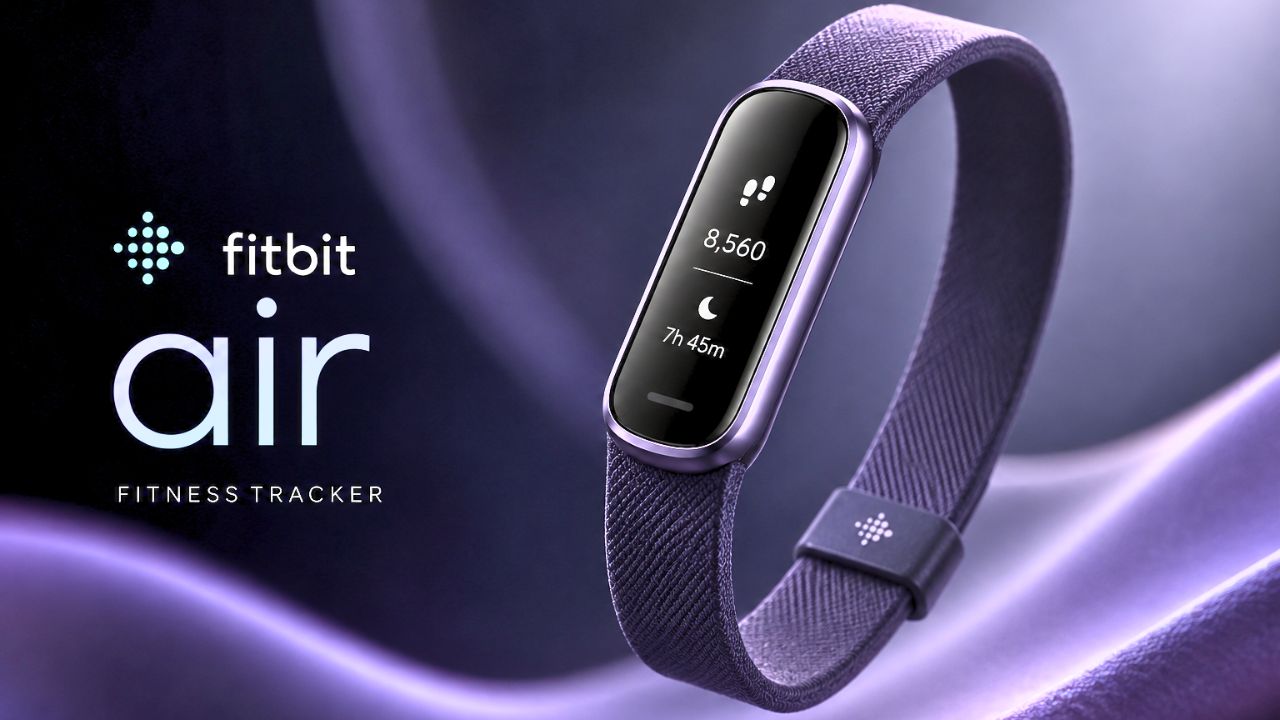
Google-owned Fitbit has officially introduced a new wearable called Fitbit Air, and it immediately stands out because of one simple reason. Unlike most fitness-focused smart bands in this category, it does not require a mandatory subscription to use its core features.
That alone makes it interesting, especially at a time when devices like Whoop have become heavily associated with monthly membership plans. Fitbit Air takes a different approach. It focuses on lightweight fitness tracking, long battery life, and AI-driven health insights while keeping the hardware simple.
A screenless wearable designed for all-day tracking
Fitbit Air follows the same overall idea as products like Whoop or Amazfit Helio. It does not have a display, which means the focus is entirely on passive tracking rather than constant interaction on the wrist.
Instead of checking stats directly on the device, users can see everything inside the Fitbit app, which is now transitioning into the new Google Health app experience.
The wearable itself is extremely lightweight and compact. Fitbit says it weighs around 12g with the band attached, making it comfortable for continuous wear during sleep, workouts, and everyday activity.
Modular design with interchangeable bands
One of the more interesting hardware decisions is the removable tracking pod. The internal pod can be detached from the strap and inserted into different band styles.
Fitbit is launching multiple styles including:
- Active bands
- Elevated bands
- Performance bands
This makes the device feel more customizable than a traditional fitness tracker. The idea is similar to changing watch straps, except here the tracking hardware itself moves between accessories.
At launch, there is no official bicep band option like Whoop offers, but third-party accessories will likely appear quickly given the removable pod design.
Battery life could be one of its biggest strengths
Fitbit claims up to 7 days of battery life on a single charge, along with fast charging support that can reportedly provide a full day of usage in just 5 minutes.
If these numbers hold up in real-world use, Fitbit Air could become one of the more practical wearables for users who dislike charging devices every night.
The wearable can also store activity data locally for several days even without syncing to a phone, which adds flexibility for workouts or travel.
Fitness tracking features are heavily focused on automation
Fitbit Air automatically tracks workouts and daily activity, including things like:
- Running
- Walking
- Cycling
- Sleep tracking
- Heart rate monitoring
The automatic workout recognition is important because it removes the need to manually start activities every time. According to Fitbit, the system can also improve over time by learning from how users label workouts.
For example, if the device repeatedly detects a cycling workout and the user changes it from “Outdoor Ride” to “Mountain Bike Ride,” the system may eventually start identifying that activity correctly on its own.
Health tracking includes advanced sensors
Even though Fitbit Air is positioned as a lightweight wearable, it still includes several advanced health features.
Fitbit Air Key Specifications
| Feature | Details |
|---|---|
| Price | $99 |
| Display | No display |
| Battery Life | Up to 7 days |
| Quick Charge | 1 day usage in 5 minutes |
| GPS | Connected GPS via smartphone |
| Heart Rate Sensor | Yes |
| Blood Oxygen (SpO2) | Yes |
| Skin Temperature | Yes |
| AFib Detection | FDA-cleared background detection |
| Water Resistance | 50 meters |
| Compatibility | Android + iOS |
| App | Fitbit App / Google Health App |
One important detail is the inclusion of background AFib detection, which continuously monitors irregular heart rhythms in the background. However, manual ECG readings are not supported.
The app experience may matter more than the hardware
With screenless wearables, the software experience becomes extremely important, and Fitbit seems to be putting major focus on AI-powered health insights.
The updated Fitbit app, which is gradually becoming the Google Health app, now delivers much more detailed summaries, readiness analysis, sleep insights, and workout recommendations.
The platform also introduces conversational AI elements that can respond to user goals and adapt recommendations over time. Users can modify fitness plans directly through AI-based prompts inside the app.
For example, someone training for long-distance running can ask the app to adjust their plan, and the system automatically updates future recommendations.
Fitbit is clearly targeting Whoop users
The overall direction of Fitbit Air feels very intentional. Google appears to be targeting users who want:
- Continuous health tracking
- Lightweight wearable design
- Long battery life
- AI-driven insights
But without committing to expensive subscription-heavy platforms.
That could make Fitbit Air appealing not just to Fitbit users, but also to people considering alternatives like Whoop or other fitness-first wearables.
Final takeaway
Fitbit Air is not trying to replace a smartwatch. Instead, it is designed for users who care more about passive fitness tracking, recovery data, and health insights than notifications or apps on the wrist.
At $99 without a required subscription, it immediately becomes one of the more interesting fitness wearables announced this year. The real test, however, will depend on how accurate the tracking is and whether the AI-driven experience inside the Google Health app actually delivers meaningful value over time.