
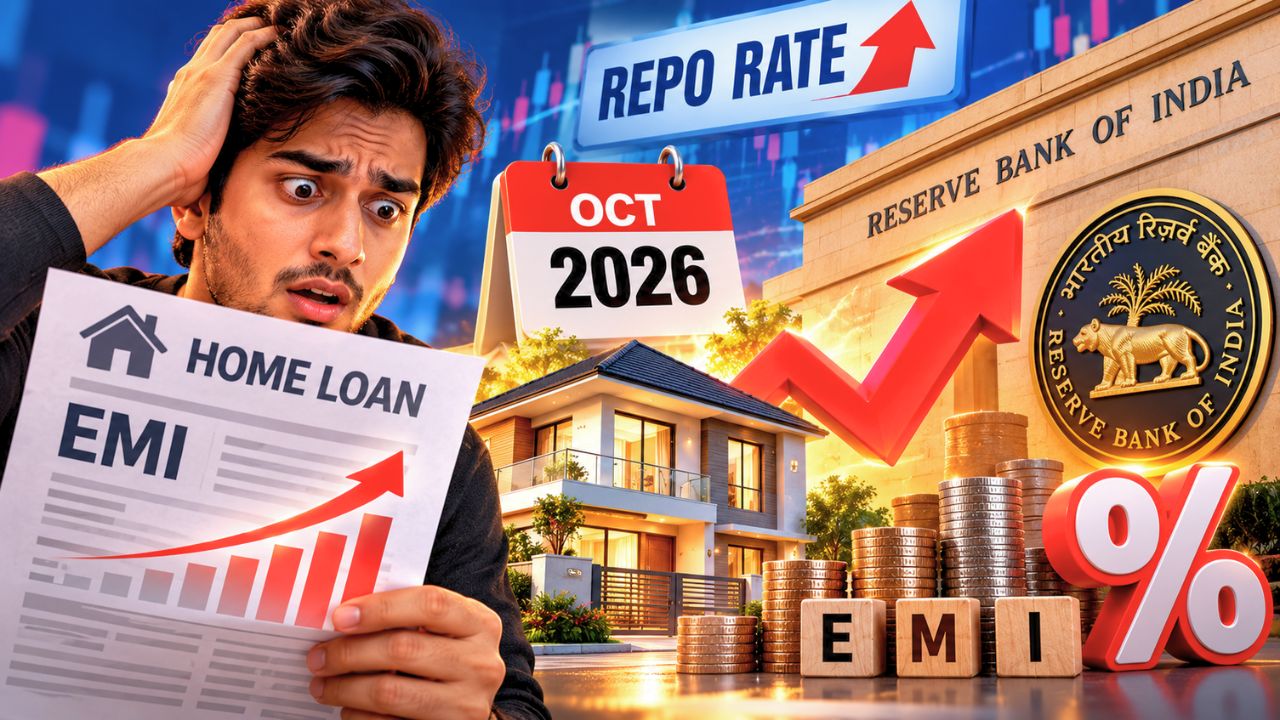
If you are currently paying a floating-rate home loan, the next few days are worth watching.
The Reserve Bank of India is scheduled to hold its Monetary Policy Committee meeting from October 5 to 7, 2026, and there is growing market attention around a possible repo rate hike.
A rate hike is not confirmed yet, but expectations have increased. Reuters reported that around 60% of economists surveyed expected the RBI to raise the repo rate at the October meeting, as inflation pressures have broadened and global interest rates have also moved higher. Reuters report on RBI October 2026 rate outlook.
So, if you have a home loan, should you be worried? Let’s understand what could actually happen to your EMI, loan tenure and interest cost.
Why Is the RBI Considering a Rate Hike?
One of the biggest reasons being discussed is the recent increase in inflation pressure.
India’s retail inflation rose to 4.82% in August 2026, up from 4.45% in July. Food inflation also increased to 5.95%. The August CPI reading was above the RBI’s 4% inflation target and marked the third consecutive month above that target.
At the same time, global interest rates have also become an important factor. The U.S. Federal Reserve raised its benchmark interest rate by 25 basis points in September, taking its target range to 3.75%-4%.
Higher global rates, inflation and rising crude oil prices can create additional pressure on India’s inflation outlook and the rupee. These are among the factors markets are watching ahead of the RBI’s October meeting.
But there is an important point here: the RBI has not announced a rate hike yet. The October 5-7 meeting is where the Monetary Policy Committee will make its decision.
What Happens to Your Home Loan If RBI Raises the Repo Rate?
This depends on the type of home loan you have.
For new floating-rate retail loans sanctioned by banks since October 2019, RBI rules require the loan to be linked to an external benchmark. The policy repo rate is one of the permitted benchmarks.
That means a repo-linked floating-rate home loan can become more expensive when the repo rate increases.
However, don’t assume that every home loan in India will immediately become more expensive after an RBI rate hike. Older loans may be linked to MCLR or other benchmarks, and the exact impact depends on your loan agreement and reset mechanism.
How Much Could Your EMI Increase?
There is no single answer because your EMI depends on several factors:
- Outstanding loan amount
- Current interest rate
- Remaining tenure
- New interest rate
- Type of benchmark
- Your lender’s spread
- Your loan’s reset frequency
For example, imagine someone has a ₹50 lakh home loan with 20 years remaining. Even a 0.25 percentage-point increase in the interest rate can change the EMI and total interest payable.
But the exact impact should be calculated using your own outstanding principal and remaining tenure rather than assuming that everyone will see the same increase.
Your Bank May Increase EMI or Loan Tenure
If your floating home loan rate increases, the change does not necessarily mean that your EMI will immediately jump by a huge amount.
RBI’s framework requires lenders to communicate the impact of changes in the external benchmark. Borrowers can be given options involving an increase in EMI, an extension of the loan tenure, or both, depending on the lender’s framework and loan terms.
For example, suppose your EMI is currently ₹45,000.
After a rate reset, the lender could structure the repayment so that:
- Option 1: EMI increases while the tenure remains closer to the existing schedule.
- Option 2: EMI stays closer to the existing amount but the loan tenure increases.
The second option may look comfortable because the monthly payment doesn’t rise as much, but a longer repayment period can mean paying more interest over the life of the loan.
Should You Increase Your EMI If Rates Go Up?
If your monthly income comfortably allows it, increasing the EMI can be one way to prevent the loan tenure from stretching too much.
The important thing is not to blindly increase the EMI. First check your monthly cash flow, emergency fund, other loans and regular expenses.
If you can comfortably pay a little more every month, the additional payment can help you reduce the outstanding principal faster and potentially lower the total interest paid over the remaining loan period.
What About Home Loan Prepayment?
If you were already planning to make a part-prepayment, a potential rate hike may be a reason to review that decision sooner rather than later.
For example, if you have a significant amount of surplus cash sitting idle and your home loan carries a relatively high interest rate, reducing the outstanding principal can lower the amount on which future interest is calculated.
However, don’t empty your emergency savings just to prepay the home loan.
Before making a large prepayment, consider your emergency fund, upcoming expenses, investment goals and whether your loan has any applicable charges or conditions.
Should You Wait Before Booking an FD?
This is where things become less certain.
FD rates may rise if banks eventually respond to a higher interest-rate environment, but there is no guarantee that every bank will increase FD rates immediately after an RBI repo rate hike.
Banks make their own deposit-rate decisions based on factors such as liquidity, deposit demand, competition and their funding requirements.
So if you’re planning a long-term FD, instead of assuming that rates will definitely rise, compare the current rates with the rates available across different banks and consider whether locking in today’s rate makes sense for your financial goals.
A possible RBI rate hike alone isn’t enough to predict exactly where FD rates will move.
What About Gold?
The original discussion also connects higher interest rates with lower gold prices, but this relationship isn’t that simple.
Gold can come under pressure when interest rates and bond yields rise because higher-yielding assets can become relatively more attractive. However, gold prices are also influenced by the U.S. dollar, central-bank buying, geopolitical risks, inflation expectations and investor demand.
So I wouldn’t make a gold-buying or selling decision solely on the assumption that “RBI hikes rates = gold will fall.”
If you’re considering gold as a long-term investment, look at the broader picture rather than trying to predict a short-term move around one RBI meeting.
What Should Home Loan Borrowers Do Right Now?
There is no need to panic just because markets are expecting a possible RBI rate hike.
Instead, check these five things:
- Find your current home loan interest rate.
- Check whether your loan is repo-linked, MCLR-linked or linked to another benchmark.
- Find out your next reset date.
- Check your outstanding principal and remaining tenure.
- Calculate how much your EMI would change if the rate increased by 0.25% or 0.50%.
This will give you a much clearer picture than simply worrying about headlines.
A Small Rate Increase Can Matter Over a Long Loan
The reason home loan borrowers pay close attention to interest rates is simple: the loan amount is usually large and the repayment period can run for 15, 20 or even 30 years.
A small change in the interest rate may not look significant when viewed monthly, but over many years, the additional interest can become meaningful.
That’s why borrowers should focus not just on the EMI but also on the total interest payable and remaining tenure.
Is an RBI Rate Hike Confirmed for October 2026?
No.
As of October 1, 2026, the RBI’s October MPC meeting is scheduled for October 5-7, but the final rate decision has not yet been announced.
There are increasing expectations of a hike because inflation has moved higher and global monetary conditions have tightened. Reuters reported that a majority of economists in its survey expected a 25-basis-point increase at the October meeting.
But an expectation is not the same thing as a confirmed policy decision.
Final Takeaway
For home loan borrowers, the upcoming RBI meeting is definitely something to keep an eye on, but there is no need to panic before the decision is announced.
If the RBI raises the repo rate and your home loan is linked to that benchmark, your interest rate could eventually increase according to the reset terms of your loan. Your lender may then adjust the EMI, extend the tenure, or use a combination of both.
The smartest thing to do right now is simple: check your loan agreement, understand your reset mechanism and calculate the impact before making any financial decision.
And if you were already planning a home loan prepayment, review your numbers carefully rather than waiting for a rate hike and then making a rushed decision.