
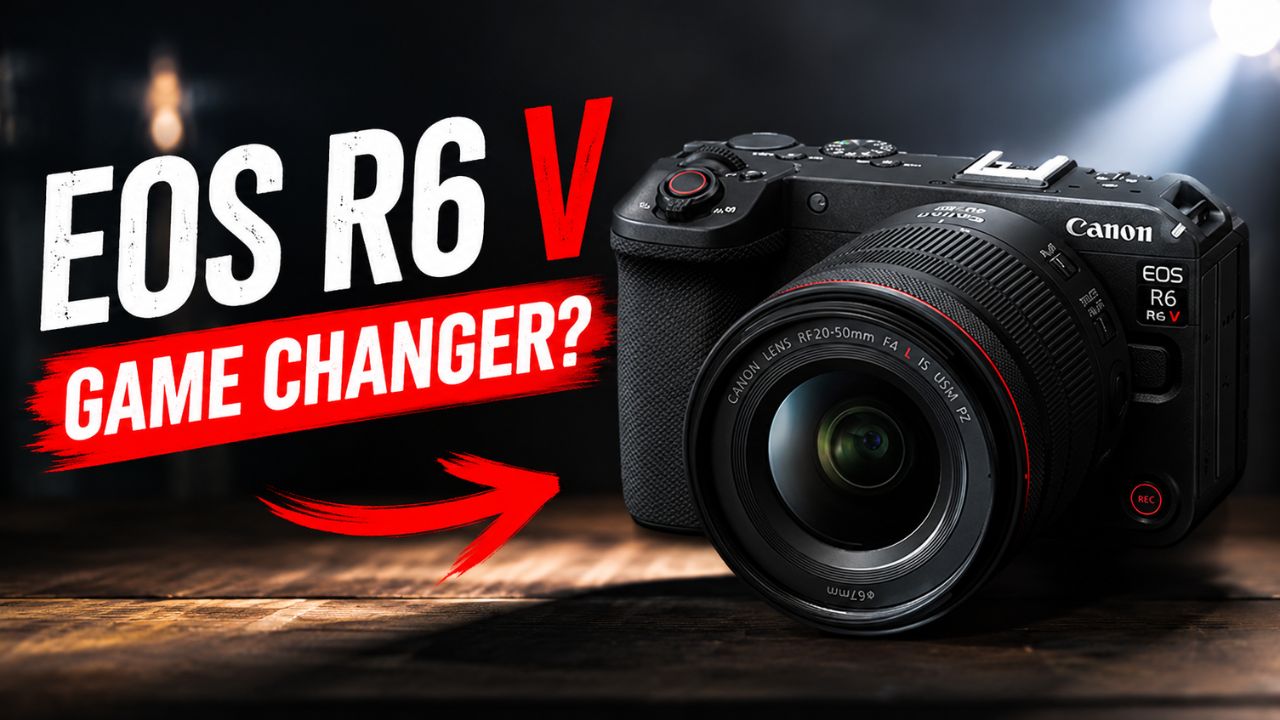
Canon has launched a lot of cameras over the last few years, but the new EOS R6 V feels different.
Instead of trying to be another hybrid camera that does a bit of everything, this one clearly leans toward video creators first. And honestly, that changes the conversation around it completely.
At first glance, the EOS R6 V looks like a mix between the EOS R6 Mark III and Canon’s cinema-focused C50. It borrows ideas from both cameras, but it also introduces a few changes that make it feel more practical for creators who shoot video most of the time.
What makes this camera interesting is not just the specs. It’s the fact that Canon seems to be trying to fill the gap between traditional mirrorless cameras and dedicated cinema cameras without pushing the price too high.
The biggest difference is the focus on video
The EOS R6 V uses the same 32MP full-frame sensor found in the EOS R6 Mark III and the Canon C50, which already gives it a strong foundation. But the real shift comes from how Canon has built the body and cooling system around video use.
Unlike the regular R6 series, this camera includes an active cooling fan system. That might sound like a small change, but it directly affects recording performance, especially for long shoots and high-quality modes like oversampled 4K 60fps.
In practical terms, this means the camera is designed to keep recording longer without overheating as quickly as traditional mirrorless bodies.
Design feels closer to a cinema camera
The first thing many people will notice is the body shape. The EOS R6 V looks boxier than a normal R6 camera and feels closer to the C50 in overall design. Canon has also removed the electronic viewfinder, which makes the body slightly smaller and more video-focused.
Canon EOS R6 V Key Specs
| Feature | Details |
|---|---|
| Sensor | 32MP Full-Frame CMOS |
| Video Recording | Up to 7K Open Gate RAW |
| Cooling | Active Cooling Fan |
| Display | Vari-angle touchscreen |
| Stabilization | IBIS supported |
| Card Slots | CFexpress Type B + SD |
| Lens Support | RF Mount |
| Video Modes | 4K Oversampled, RAW, H.265 |
| ISO | Dual Base ISO (800 / 6400 unofficially) |
The body also introduces a few creator-friendly additions like:
- Front recording button
- Dedicated photo/video switch
- Zoom rocker for power zoom lenses
- Side tripod mount for vertical shooting
These things may not sound dramatic on paper, but they make daily video work much easier.
Canon’s new 20-50mm power zoom lens changes the experience
One of the more interesting additions is Canon’s new 20-50mm F4 power zoom lens. Instead of relying on traditional manual zooming, this lens supports electronic zoom control directly from the camera body.
For creators shooting events, documentaries, weddings, or run-and-gun content, this makes the setup feel much closer to a compact cinema rig rather than a standard mirrorless camera.
The lens is also noticeably lighter than Canon’s traditional zoom lenses, which helps the entire setup stay more manageable during long shoots.
Real-world overheating performance looks much better
Thermal performance is one of the biggest reasons this camera exists.
Testing showed that:
- In oversampled 4K 60fps, the camera could record around 1.5 hours on low fan settings before overheating
- With medium or high fan settings, recording times stretched to nearly 3 hours in controlled conditions
That is a huge improvement compared to many traditional mirrorless cameras that struggle with long-form recording.
Of course, fan noise becomes more noticeable on higher settings, especially in quieter environments, but for most creators, longer recording times will matter more.
Video features clearly come first here
Canon has made it obvious that the EOS R6 V is designed mainly for video shooters.
The camera supports:
- 7K Open Gate RAW recording
- Oversampled 4K recording
- Canon Log workflows
- Focus peaking and false color tools
- Advanced codec options
At the same time, the menu system still feels more user-friendly than Canon’s cinema cameras, which may actually help creators moving up from beginner setups.
But it still isn’t a full cinema camera replacement
Even though the EOS R6 V borrows a lot from the C50, there are still differences.
The C50 still offers:
- Better thermal handling
- Full cinema menu controls
- Built-in ND filters
- XLR audio support
- More advanced customization
That means the EOS R6 V sits somewhere in between a traditional hybrid camera and a dedicated cinema camera.
And honestly, that might be exactly why it becomes popular.
Who this camera actually makes sense for
If you mainly shoot photography, the regular EOS R6 Mark III probably still makes more sense because of the electronic viewfinder and traditional photo-focused handling.
But if video is your main priority, the EOS R6 V feels like the more logical choice.
It especially fits:
- YouTubers
- Wedding filmmakers
- Documentary creators
- Run-and-gun shooters
- Hybrid creators leaning heavily toward video
Final takeaway
The Canon EOS R6 V feels like Canon finally acknowledging that many creators care more about video practicality than traditional camera design.
It takes the image quality and sensor performance people already liked from the R6 series and reshapes the experience around long-form video shooting. The active cooling system, creator-focused controls, and more compact cinema-style design all push it in that direction.
It is not a perfect replacement for a cinema camera, and it is not the ideal photography-first body either. But for creators who spend most of their time shooting video, this may end up being one of Canon’s most balanced releases in a long time.





![How to reduce battery drain after [AndroidiOS version] update](https://unifite.in/wp-content/uploads/2026/10/How-to-reduce-battery-drain-after-AndroidiOS-version-update-100x70.jpg "How to Reduce Battery Drain After an Android or iOS Update (2026)")
![Best educational apps for adults learning [skill]](https://unifite.in/wp-content/uploads/2026/10/Best-educational-apps-for-adults-learning-skill-100x70.jpg "Best Educational Apps for Adults Learning New Skills in 2026")