
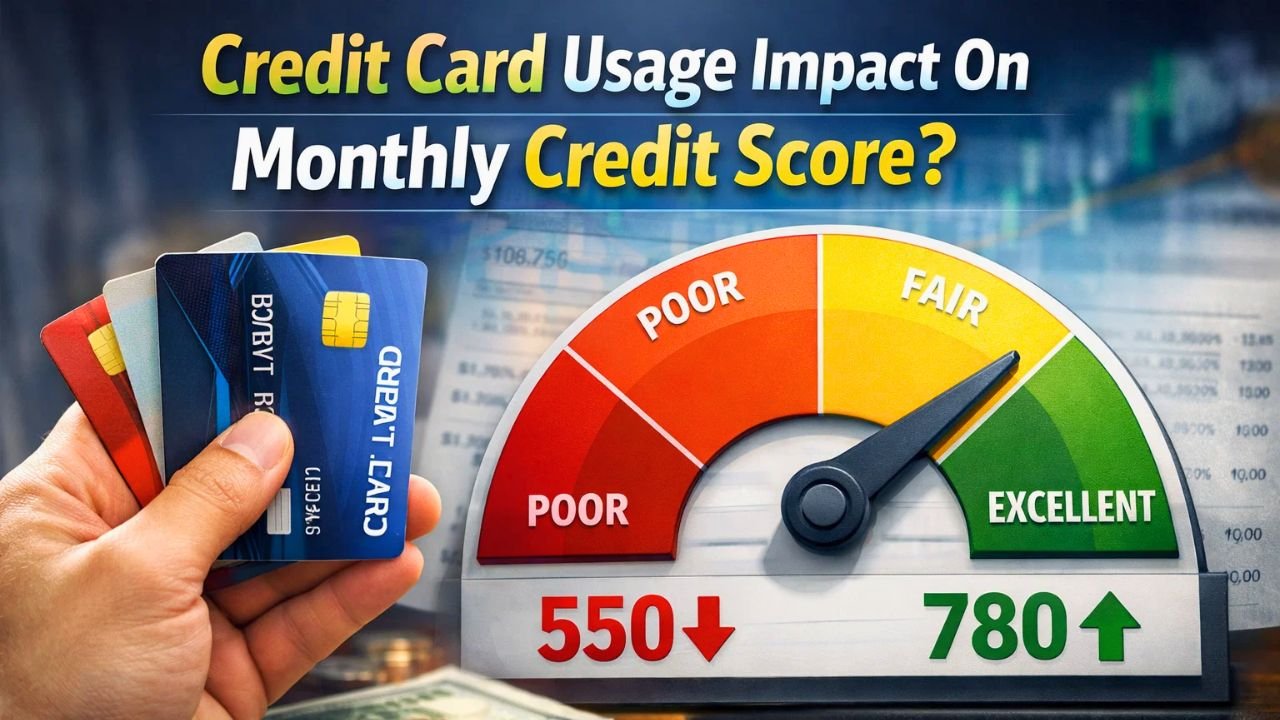
Your credit score does not randomly go up or down. It changes based on behavior. And one of the biggest factors affecting it every single month is credit card usage.
Many people think simply owning a credit card affects their score. That’s not true. What really matters is how you use your credit card, how much of your limit you use, whether you pay on time, and how long balances stay unpaid.
In this guide, we’ll break down the real credit card usage impact on monthly credit score, explain how credit utilization works, and show what habits help improve your score steadily.
What is a credit score and why it changes monthly
A credit score is a three-digit number that represents your creditworthiness. In India, this usually refers to a CIBIL score, and it typically ranges between 300 and 900.
Your score can change monthly because:
- Lenders report new activity to credit bureaus
- Payments get updated
- Credit utilization changes
- New credit inquiries are added
- Old balances get cleared
That means your monthly credit score impact depends heavily on how responsibly you manage your credit card.
How Credit Card Usage Impact On Monthly Credit Score
Credit card usage impacts your score mainly through three important factors:
- Credit utilization ratio
- Payment history
- Credit behavior consistency
Let’s break each one down clearly.
Credit utilization ratio – the most important factor
Your credit utilization ratio is the percentage of your total credit limit that you are using.
Formula:
Credit Utilization = (Used Credit ÷ Total Credit Limit) × 100
Example:
- Credit limit = ₹1,00,000
- Used amount = ₹50,000
- Utilization = 50%
High credit utilization can negatively affect your monthly credit score, even if you pay on time.
Recommended credit utilization level
Most financial experts suggest:
- Keep utilization below 30%
- Below 10% is even better for strong credit profiles
If your card limit is ₹1,00,000, try not to exceed ₹30,000 usage regularly.
Payment history – on-time payments matter most
Your payment history has the strongest impact on your credit score.
If you:
- Pay the full amount on time → Positive impact
- Miss payment or delay payment → Negative impact
Even one late payment can reduce your score. And that late record may stay on your credit report for months or years.
This is why responsible credit card usage means never missing a due date.
Minimum due vs full payment impact on credit score
Paying only the minimum due:
- Protects you from being marked as late
- But increases interest
- Keeps utilization high
- May slow down score improvement
Paying full statement balance:
- Keeps utilization lower
- Prevents interest charges
- Improves overall credit profile
While minimum payment avoids default reporting, consistent full payment supports stronger credit score growth.
How high credit card balances affect monthly credit score
Even if you pay on time, carrying high balances can reduce your score temporarily.
Why?
Because credit bureaus see high usage as higher risk.
For example:
- Month 1: You use 20% of limit → Score stable
- Month 2: You use 80% of limit → Score may drop
- Month 3: You reduce balance to 10% → Score may recover
That’s why credit utilization impact on credit score is very real and visible month to month.
Does frequent credit card usage reduce credit score?
Using your credit card frequently is not a problem.
High usage percentage is the problem.
You can swipe your card daily, but if:
- You keep balance low
- You pay on time
- You manage utilization properly
Then frequent usage can actually build positive history.
How new credit cards impact monthly credit score
When you apply for a new credit card:
- A hard inquiry is recorded
- Your average credit age may reduce
This can cause a small temporary drop in score. However:
- Responsible use over time improves it again
Applying for too many cards in a short period can negatively impact your credit score impact from credit card applications.
Credit card closing impact on credit score
Closing a credit card can:
- Reduce your total credit limit
- Increase utilization ratio
- Shorten credit history
If you close an old card with high limit, your monthly credit score may drop due to increased utilization percentage.
How long does credit card usage affect credit score?
Credit card usage impacts your score every time lenders report to credit bureaus.
Most lenders report monthly. That means:
- Your spending this month
- Your payment behavior
- Your outstanding balance
All can influence next month’s credit score.
This is why consistent behavior matters more than occasional large payments.
Positive habits that improve credit score monthly
If you want steady improvement:
- Keep credit utilization below 30%
- Pay full statement balance before due date
- Avoid missing payments
- Avoid unnecessary credit card applications
- Maintain older credit cards
- Monitor your credit report regularly
Small disciplined habits create strong long-term credit health.
Negative habits that hurt credit score
- Late payments
- High utilization for long periods
- Only paying minimum due for months
- Maxing out credit cards
- Applying for multiple credit cards at once
These behaviors signal financial stress to credit bureaus.
Example: Monthly credit score impact scenario
Let’s say someone has:
- Credit limit: ₹2,00,000
- Uses ₹1,60,000
- Utilization: 80%
Even if payment is on time, the high utilization may reduce the score.
Next month:
- Balance reduced to ₹20,000
- Utilization drops to 10%
Credit score may improve again after reporting cycle.
This shows how strongly credit card usage impact on monthly credit score depends on utilization behavior.
Frequently Asked Questions
Does using credit card increase credit score?
Yes, if used responsibly with on-time full payments and low utilization.
Does checking credit score reduce it?
No. Checking your own credit score is a soft inquiry and does not affect it.
How much credit utilization is safe?
Generally below 30% is considered safe.
How quickly can credit score improve?
Improvement depends on consistent positive behavior. Changes are usually visible after monthly reporting cycles.
Final thoughts
The credit card usage impact on monthly credit score is real and measurable. The good news is that you control most of it. Your spending pattern, repayment discipline, and credit utilization ratio directly influence your score every month. Responsible credit card usage does not harm your credit score. In fact, when managed properly, it becomes one of the strongest tools for building excellent credit health.
Important disclaimer: Loan approvals, credit score changes, and credit reporting timelines depend on lender policies and credit bureau updates. Individual results may vary based on overall credit profile.