
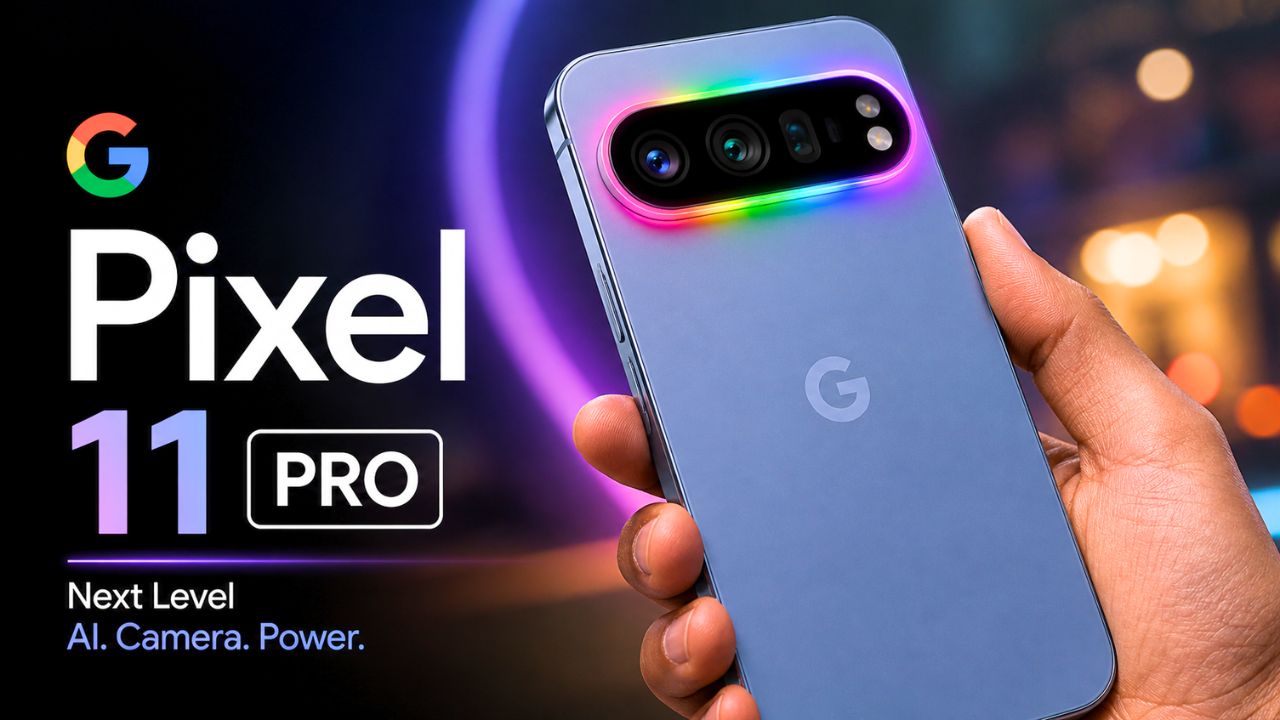
The Google Pixel 11 Pro is still months away from launch, but new leaks are already giving us a much clearer picture of what Google is planning this year. While the overall design may look familiar at first glance, some of the rumored changes are surprisingly different from previous Pixel phones, especially when it comes to AI features and the redesigned camera bar.
One feature that is getting a lot of attention right now is something reportedly called “Pixel Glow,” and honestly, it could end up becoming one of the most recognizable additions to the Pixel lineup in years.
What is Pixel Glow and why it changes the camera bar
According to information discovered in Android 17 beta code, Google may be adding a new lighting system called Pixel Glow to the Pixel 11 series. The idea appears to be fairly simple but visually interesting. Instead of using the camera bar purely for cameras and sensors, Google could integrate hidden LEDs underneath it.
This would allow the entire camera bar to light up for things like:
- Notifications
- Gemini Live interactions
- Charging animations
- Incoming calls and alerts
Reports also suggest that different animation styles may be supported, including breathing effects, flashing patterns, and color transitions.
What makes this leak more believable is that it also explains why the camera bar design appears different in recent renders. Unlike older Pixel devices where the camera bar matched the body color, the Pixel 11 Pro reportedly uses a completely blacked-out bar, likely to hide the LEDs underneath.
Tensor G6 confusion explained
Another topic that sparked discussion recently is the Tensor G6 processor. Some reports initially claimed Google was using an older GPU architecture, which led to criticism online. However, newer information suggests the situation is more complicated than that.
The Tensor G6 is reportedly being built on a 2nm process, which could bring noticeable improvements in efficiency, thermal management, and AI performance. The GPU itself may be based on an updated version with newer Vulkan support and higher clock speeds.
In simpler terms, the focus this year does not appear to be raw benchmark performance alone. Google seems more interested in improving sustained performance, AI processing, and battery efficiency during real-world use.
AI is becoming the biggest part of the Pixel experience
The Pixel lineup has always leaned heavily into software and AI, but the Pixel 11 Pro could take that even further.
Leaks suggest Google is testing major AI-powered video upgrades, especially in low-light conditions. One rumored feature claims the phone may be capable of recording usable video even in extremely dark environments around 5 to 10 lux, which is close to near darkness.
There are also reports of:
- AI-assisted 100x zoom
- Video object removal
- Noise repair tools
- AI background editing inside videos
What makes this interesting is that these tools may work directly inside the Google Photos app instead of requiring separate editing software.
If these features actually work well in real-world conditions, the Pixel 11 Pro could become one of the strongest AI-focused camera phones yet.
Pixel 11 Pro specifications leaked so far
While Google has not officially confirmed the hardware yet, multiple leaks are pointing toward a fairly premium setup for the Pixel 11 Pro.
Google Pixel 11 Pro Expected Specifications
| Feature | Expected Details |
|---|---|
| Display | 6.4-inch LTPO OLED, 120Hz |
| Resolution | 1344 × 2868 |
| Protection | Gorilla Glass Victus 3 |
| Processor | Tensor G6 (2nm) |
| RAM | Up to 16GB |
| Storage | Up to 1TB UFS 4.0 |
| Main Camera | 50MP |
| Ultra-wide Camera | 48MP |
| Periscope Zoom Camera | 64MP, 10x optical zoom |
| Selfie Camera | 42MP |
| Battery | 5100mAh |
| Wired Charging | 45W |
| Wireless Charging | G2 magnetic wireless charging |
| Software | Android 17 |
| Connectivity | Wi-Fi 7, Bluetooth 5.4, 5G |
| Expected Launch | August 2026 |
| Expected Price | Starting around $999 |
Battery and charging may finally improve
Battery life has not always been the strongest area for Pixel phones, but this year Google appears to be focusing more seriously on efficiency.
The combination of:
- Larger battery sizes
- 2nm Tensor G6 efficiency
- Improved thermal management
could lead to noticeably better endurance compared to older models.
There are also rumors about easier battery replacement systems based on Google patents, although this part remains highly speculative for now.
The design changes are subtle but intentional
From the front, the Pixel 11 Pro still looks very similar to previous Pixel generations. The biggest changes appear on the back, where the redesigned camera bar and lighting system create a more distinct identity.
The temperature sensor from older Pro models is reportedly gone, which honestly makes sense. Most users rarely used it after trying it once or twice. Replacing that space with something more interactive feels like a smarter decision.
Should Pixel 10 users upgrade
At least based on current leaks, the Pixel 11 Pro does not look like a dramatic redesign. The biggest upgrades seem to focus on AI features, camera processing, and efficiency rather than changing the overall experience completely.
For users already on a Pixel 10 Pro, this may not feel like an urgent upgrade. But for people using older Pixel devices, or anyone interested in AI-focused smartphone features, the Pixel 11 Pro is starting to look much more interesting.
Final takeaway
The Google Pixel 11 Pro may not reinvent the Pixel lineup visually, but the leaked features suggest Google is doubling down on AI, camera software, and smarter everyday interactions. Features like Pixel Glow, advanced AI video editing, and the new Tensor G6 point toward a phone that feels more intelligent rather than simply more powerful.
If these leaks turn out to be accurate, the Pixel 11 Pro could become one of Google’s most ambitious Pixel phones yet, especially for users who care more about software experience and AI features than pure hardware specs.